




About

Contact

Parents of Tutornest complained that finding and booking the right tutor, on the previous experience often felt overwhelming for them and the students. This resulted in Decision overload causing Low conversion rate, Friction in checkout & Scheduling leading to an Increase in cart abandonment. Ultimately contributing to a under optimized user experience, and that meant Reduced user retention and repeat bookings.


To address these challenges, key design improvements had to be implemented in the user experience which includes:


Clear Tutor Cards

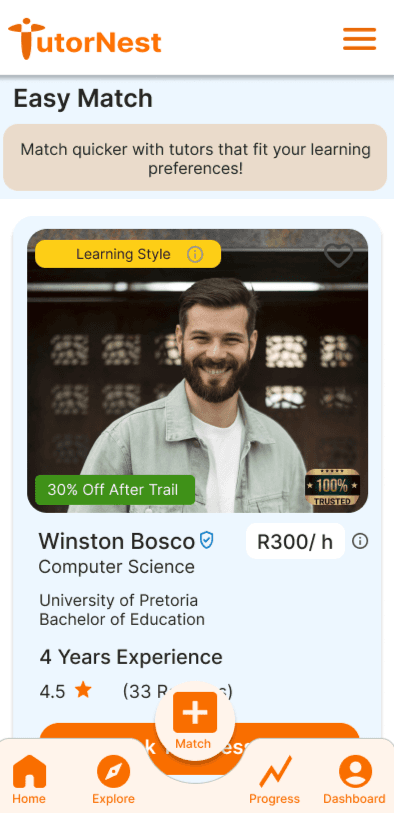
Tutor profiles now highlight only the most critical information at a glance


Trust Signals

I integrated credibility badges that tackles the trust gap and gives parents confidence in their choices- potentially leading to repeat bookings.


Tutor Availability Calendar

This would solve the scheduling friction that causes booking delays.


Faster Checkout Flow

Which would reduce abandonment and increase booking completion by 20%

Problem

Solution

I reviewed existing tutoring apps like Preply, Superprof, Wyzant to identify gaps. Some gaps included overly complex booking flows, lack of trust signals and poor mobile optimization.


Opportunity- Design a simpler, trust-driven experience focused on mobile-first usability.


I conducted informal interviews and surveys with parents (target users) to inform my design decisions:


Design Descision

User Research

My Role:

Product

Designer

Est. Booking completion rate

20%

Est. Conversion rate

15%

Duration:

14 weeks


Age: 42

Marital status: Married

Occupation: Nurse

Location: Stellenbosch, W Western Cape

Sarah White

Goals

She wants to see tangible academic improvement in her son, specifically improved test scores and grades.

She’s wanting a trustworthy and qualified tutors who will be able to pinpoint and understand her child’s academic needs.

Frustrations

She wants a reliable and safe online tutoring service but she’s indecisive and needs effective proof of results and value which she hasn’t really seen yet.

Sarah often wonders if the tutor would adapt to her child's needs not sure whether she’d get value for the money spent on tutoring.

Bio

Sarah often feels she doesn't have the time to actively manage her children's education. She feels overwhelmed at times, finding it difficult to help her son with current schoolwork and recognizes when they need extra help. She’s willing to seek external support but is still skeptical using online platforms as she want a tutor she can trust to help her son succeed academically.

Action

Parent notices child is struggling with schoolwork

Parent looking for a tutor/tutoring service.

Parent evaluates potential tutors or platforms

Parent books sessions, handles payment, and sorts out the schedule

Child attends tutoring sessions

Parent reviews the child's academic performance (test scores, grades)

-Try to help child with homework

-Get into contact with teacher

-Ask around for recommendations of tutor platforms

-Seek proof of effectiveness through testimonials.

-Communicate initial needs or expectations to the tutor.

-Observes changes in child's attitude

-Concered child might fail

-Where do I even start?

-Is online tutoring reliable?"


-"Is it worth the money?

-"Is this tutor trustworthy?

-Hopeful about the sessions starting

-"Are they making progress?"

-"Is my child comfortable?"

-Offer initial assessments to help parents pinpoint needs.

- Offer transparent pricing

-Offer guidance on preparing for the first session.

-Facilitate regular communication or feedback from the tutor

-Facilitate communication (e.g., trial sessions, initial chat) to help build trust

Task List

Feeling

adjective

Improvement

Oppertunities

Paper-Wireframes

Design

Medium-Fidelity Wireframes

Mockups

TutorNest

If you had a magic button that fixed one part of the tutoring process, what would it fix?


I think scheduling to be honest . A button that aligned my calendar, the tutor’s, and my child’s perfectly every week would be a dream.

What would make you stop using a tutoring service even if the sessions are good?


If I didn’t see any clear academic improvement over time, like test scores or grades going up. I’d question the long-term value and consider stopping.

What makes you feel confident that a tutor is trustworthy and right for your child?


Someone who has some kind of education and experience

Information Architecture

Onboarding

Screen

Do you have an account?

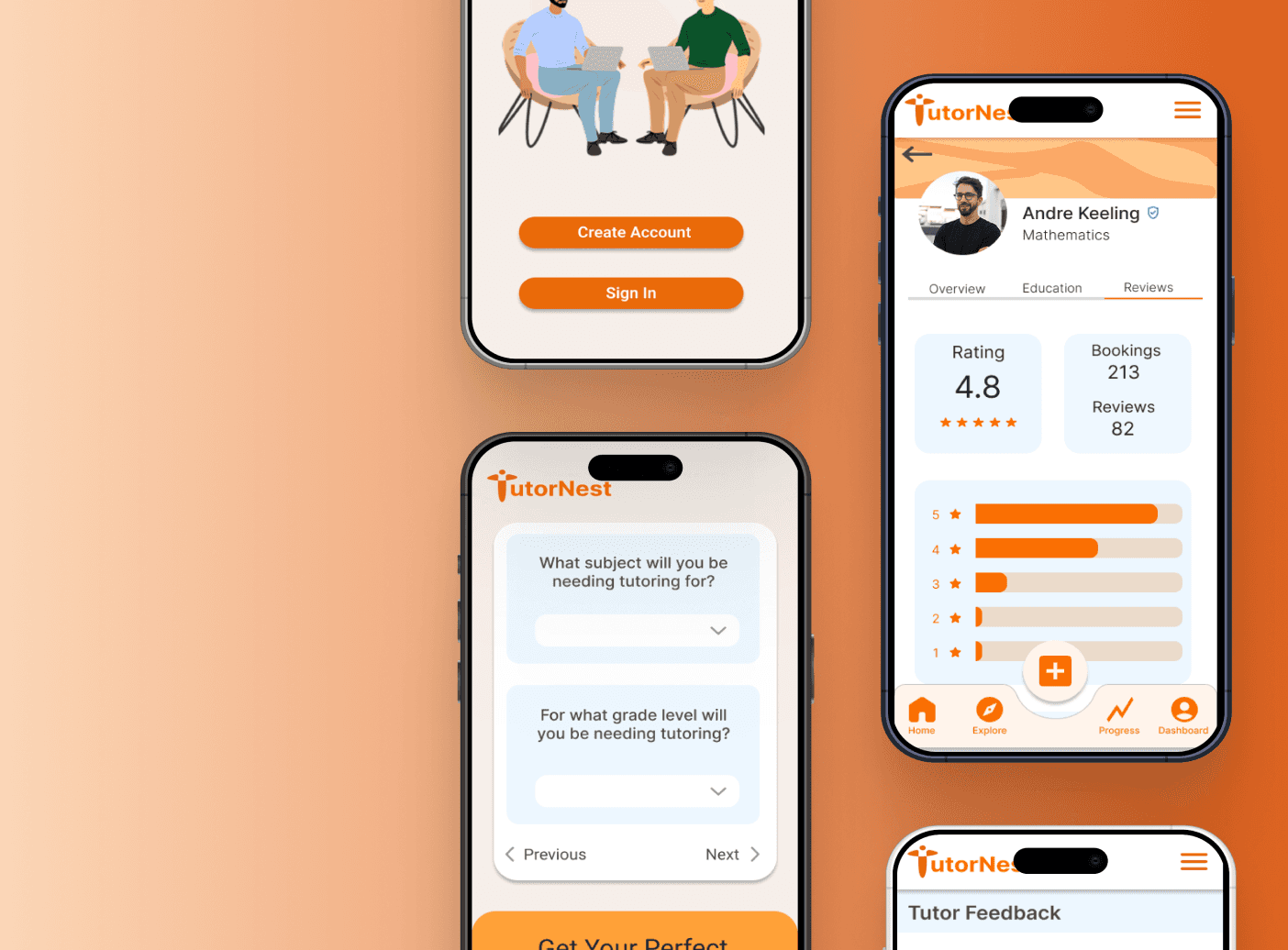
Create Account

Sign In

Email

Email

Password

Password

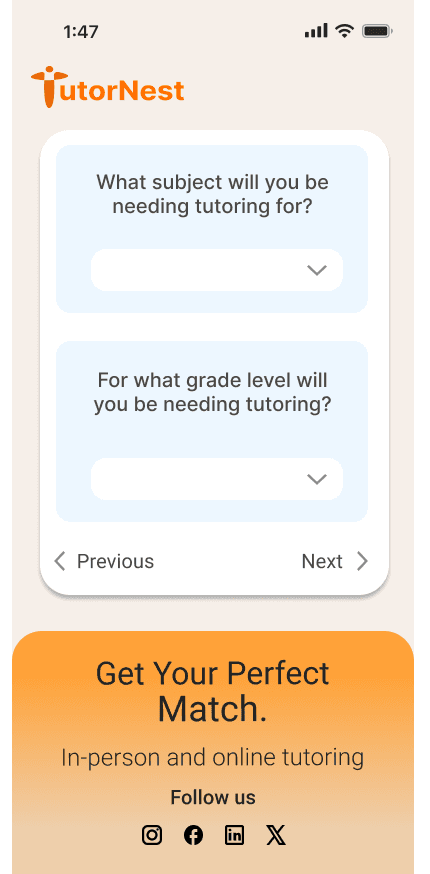
Do you want to match with tutor?

Yes

No

Yes

No

Skip to browse

Continue

Tutor matching questions 1/2

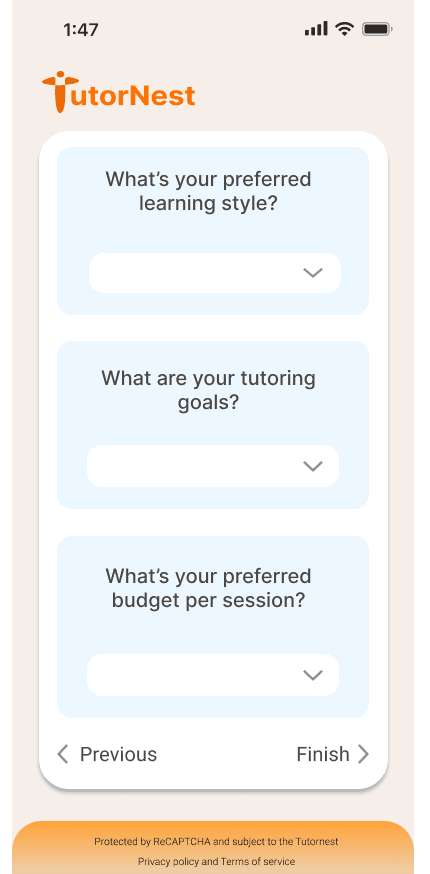
Tutor matching questions 2/2

Home Screen

Booking Confirmed

Explore Tutors

Easy Match

Tutor Feedback

Home Screen

Tutor Details

(Availability, Reviews, Achievements.)

Book Tutor

(Checkout Summary)

Project Impact

Through designing TutorNest I’ve learned that:


Trust is the currency of online education.

Ratings and reviews alone aren’t enough. Parents want visible signals of credibility


Speed to action matters.

By compressing the checkout into a two-step flow and surfacing availability upfront, I saw how much impact simplification has on retention and satisfaction.


Design is a business lever.

For example, surfacing availability and rates earlier in the flow directly supports higher booking conversions and reduced abandonment.


Future Iterations


If TutorNest were developed further, I’d focus on:


AI-Powered Matching- Which would Improve tutor utilization rates and increase repeat sessions.


Find opportunities for upselling- This would include for example premium features and tailored progress reports and special tutor discounts.


Accessibility & Inclusivity Enhancements- That would refine contrast ratios, introduce language localization, and looking into adding voice support for younger learners.


Continuous Usability Testing- Running A/B tests on tutor card layouts, review displays, and checkout flows to continuously validate assumptions.

Prototype

Let’s Connect

From the parent feedback and survey data, I was able to create User persona and - journey map:


Personas and User Journey

Parents of Tutornest complained that finding and booking the right tutor, on the previous experience often felt overwhelming for them and the students. This resulted in Decision overload causing Low conversion rate, Friction in checkout & Scheduling- leading to an Increase in cart abandonment. Ultimately contributing to a under optimized user experience, and that meant- Reduced user retention and repeat bookings.


To address these challenges, key design improvements had to be implemented in the user experience which includes:


Clear Tutor Cards

Tutor profiles now highlight only the most critical information at a glance


Trust Signals

I integrated credibility badges that tackles the trust gap and gives parents confidence in their choices- potentially leading to repeat bookings.


Tutor Availability Calendar

This would solve the scheduling friction that causes booking delays.


Faster Checkout Flow

Which would reduce abandonment and increase booking completion by 20%

TutorNest

Problem

Solution

I reviewed existing tutoring apps like Preply, Superprof, Wyzant to identify gaps. Some gaps included overly complex booking flows, lack of trust signals and poor mobile optimization.


Opportunity- Design a simpler, trust-driven experience focused on mobile-first usability.


I conducted informal interviews and surveys with parents (target users) to inform my design decisions:


From the parent feedback and survey data, I was able to create User persona and - journey map:


Design Descision

User Research

Personas and User Journey

Goals

She wants to see tangible academic improvement in her son, specifically improved test scores and grades.

She’s wanting a trustworthy and qualified tutors who will be able to pinpoint and understand her child’s academic needs.

Bio

Sarah often feels she doesn't have the time to actively manage her children's education. She feels overwhelmed at times, finding it difficult to help her son with current schoolwork and recognizes when they need extra help. She’s willing to seek external support but is still skeptical using online platforms as she want a tutor she can trust to help her son succeed academically.

Frustrations

She wants a reliable and safe online tutoring service but she’s indecisive and needs effective proof of results and value which she hasn’t really seen yet.

Sarah often wonders if the tutor would adapt to her child's needs not sure whether she’d get value for the money spent on tutoring.

Age: 42

Marital status: Married

Occupation: Nurse

Location: Stellenbosch, W Western Cape

Age: 42

Marital status: Married

Occupation: Nurse

Location: Stellenbosch, W Western Cape

Sarah White

Sarah White

Action

Parent notices child is struggling with schoolwork

Parent looking for a tutor/tutoring service.

Parent evaluates potential tutors or platforms

Parent books sessions, handles payment, and sorts out the schedule

Child attends tutoring sessions

Parent reviews the child's academic performance (test scores, grades)

-Try to help child with homework

-Get into contact with teacher

-Ask around for recommendations of tutor platforms

-Seek proof of effectiveness through testimonials.

-Communicate initial needs or expectations to the tutor.

-Observes changes in child's attitude

-Concered child might fail

-Where do I even start?

-Is online tutoring reliable?"


-"Is it worth the money?

-"Is this tutor trustworthy?

-Hopeful about the sessions starting

-"Are they making progress?"

-"Is my child comfortable?"

-Offer initial assessments to help parents pinpoint needs.

- Offer transparent pricing

-Offer guidance on preparing for the first session.

-Facilitate regular communication or feedback from the tutor

-Facilitate communication (e.g., trial sessions, initial chat) to help build trust

Task List

Feeling

adjective

Improvement

Oppertunities

Medium-Fidelity Wireframes

Paper-Wireframes

Mockups

Mockups

Design

If you had a magic button that fixed one part of the tutoring process, what would it fix?


I think scheduling to be honest . A button that aligned my calendar, the tutor’s, and my child’s perfectly every week would be a dream.

What would make you stop using a tutoring service even if the sessions are good?


If I didn’t see any clear academic improvement over time, like test scores or grades going up. I’d question the long-term value and consider stopping.

What makes you feel confident that a tutor is trustworthy and right for your child?


Someone who has some kind of education and experience

Information Architecture

Onboarding

Screen

Do you have an account?

Create Account

Sign In

Email

Email

Password

Password

Do you want to match with tutor?

Yes

No

Yes

No

Skip to browse

Continue

Tutor matching questions 1/2

Tutor matching questions 2/2

Home Screen

Booking Confirmed

Explore Tutors

Easy Match

Tutor Feedback

Home Screen

Tutor Details

(Availability, Reviews, Achievements.)

Book Tutor

(Checkout Summary)

Project Impact

Through designing TutorNest I’ve learned that:


Trust is the currency of online education.

Ratings and reviews alone aren’t enough. Parents want visible signals of credibility


Speed to action matters.

By compressing the checkout into a two-step flow and surfacing availability upfront, I saw how much impact simplification has on retention and satisfaction.


Design is a business lever.

For example, surfacing availability and rates earlier in the flow directly supports higher booking conversions and reduced abandonment.


Future Iterations


If TutorNest were developed further, I’d focus on:


AI-Powered Matching- Which would Improve tutor utilization rates and increase repeat sessions.


Find opportunities for upselling- This would include for example premium features and tailored progress reports and special tutor discounts.


Accessibility & Inclusivity Enhancements- That would refine contrast ratios, introduce language localization, and looking into adding voice support for younger learners.


Continuous Usability Testing- Run A/B tests on tutor card layouts, review displays, and checkout flows to continuously validate assumptions.

Let’s Connect

My Role:

UX/ Product Designer

Est. Booking completion rate

20%

Est. Conversion rate

15%

Duration:

14 weeks


Grethan Pienaar 2026 | Designer | grethanpienaar@gmail.com

Parents of Tutornest complained that finding and booking the right tutor, on the previous experience often felt overwhelming for them and the students. This resulted in Decision overload causing Lower conversion rate, Friction in checkout & Scheduling leading to an Increase in cart abandonment. Ultimately contributing to a under optimized user experience, and that meant Reduced user retention and repeat bookings.


To address these challenges, key design improvements had to be implemented in the user experience which includes:


Clear Tutor Cards

Tutor profiles now highlight only the most critical information at a glance (education and experience) with clear tutor images.-


Trust Signals

I integrated credibility badges (Learning style, Tutor trust badge and tutor verification badge) in combination with free trail booking and booking discounts that signals trust leading to higher conversion rate.


Tutor Availability Calendar

This would solve the scheduling friction that causes booking delays.


Faster Checkout Flow

Which would reduce abandonment and increase booking completion by 20%

TutorNest

Problem

Solution

I reviewed existing tutoring apps like Preply, Superprof, Wyzant to identify gaps. Some gaps included overly complex booking flows, lack of trust signals and poor mobile optimization.


Opportunity- Design a simpler, trust-driven experience focused on mobile-first usability.


I conducted informal interviews and surveys with parents (target users) to inform my design decisions:


From the parent feedback and survey data, I was able to create User persona and - journey map:


Medium-Fidelity Wireframes

Paper-Wireframes

Information Architecture

Mockups

Project Impact

Design Descision

User Research

Personas and User Journey

Goals

She wants to see tangible academic improvement in her son, specifically improved test scores and grades.

She’s wanting a trustworthy and qualified tutors who will be able to pinpoint and understand her child’s academic needs.

Bio

Sarah often feels she doesn't have the time to actively manage her children's education. She feels overwhelmed at times, finding it difficult to help her son with current schoolwork and recognizes when they need extra help. She’s willing to seek external support but is still skeptical using online platforms as she want a tutor she can trust to help her son succeed academically.

Frustrations

She wants a reliable and safe online tutoring service but she’s indecisive and needs effective proof of results and value which she hasn’t really seen yet.

Sarah often wonders if the tutor would adapt to her child's needs not sure whether she’d get value for the money spent on tutoring.

Age: 42

Marital status: Married

Occupation: Nurse

Location: Stellenbosch, Western Cape

Sarah White

Action

Parent notices child is struggling with schoolwork

Parent looking for a tutor/tutoring service.

Parent evaluates potential tutors or platforms

Parent books sessions, handles payment, and sorts out the schedule

Child attends tutoring sessions

Parent reviews the child's academic performance (test scores, grades)

-Try to help child with homework

-Get into contact with teacher

-Ask around for recommendations of tutor platforms

-Seek proof of effectiveness through testimonials.

-Communicate initial needs or expectations to the tutor.

-Observes changes in child's attitude

-Concered child might fail

-Where do I even start?

-Is online tutoring reliable?"


-"Is it worth the money?

-"Is this tutor trustworthy?

-Hopeful about the sessions starting

-"Are they making progress?"

-"Is my child comfortable?"

-Offer initial assessments to help parents pinpoint needs.

- Offer transparent pricing

-Offer guidance on preparing for the first session.

-Facilitate regular communication or feedback from the tutor

-Facilitate communication (e.g., trial sessions, initial chat) to help build trust

Task List

Feeling

adjective

Improvement

Oppertunities

Design

If you had a magic button that fixed one part of the tutoring process, what would it fix?


I think scheduling to be honest . A button that aligned my calendar, the tutor’s, and my child’s perfectly every week would be a dream.

What would make you stop using a tutoring service even if the sessions are good?


If I didn’t see any clear academic improvement over time, like test scores or grades going up. I’d question the long-term value and consider stopping.

What makes you feel confident that a tutor is trustworthy and right for your child?


Someone who has some kind of education and experience

Onboarding

Screen

Do you have an account?

Create Account

Sign In

Email

Email

Password

Password

Do you want to match with tutor?

Yes

No

Yes

No

Skip to browse

Continue

Tutor matching questions 1/2

Tutor matching questions 2/2

Home Screen

Booking Confirmed

Explore Tutors

Easy Match

Tutor Feedback

Home Screen

Tutor Details

(Availability, Reviews, Achievements.)

Book Tutor

(Checkout Summary)

Through designing TutorNest I’ve learned that:


Trust is the currency of online education.

Ratings and reviews alone aren’t enough. Parents want visible signals of credibility


Speed to action matters.

By compressing the checkout into a two-step flow and surfacing availability upfront, I saw how much impact simplification has on retention and satisfaction.


Design is a business lever.

For example, surfacing availability and rates earlier in the flow directly supports higher booking conversions and reduced abandonment.


Future Iterations


If TutorNest were developed further, I’d focus on:


AI-Powered Matching- Which would Improve tutor utilization rates and increase repeat sessions.


Find opportunities for upselling- This would include for example premium features and tailored progress reports and special tutor discounts.


Accessibility & Inclusivity Enhancements- That would refine contrast ratios, introduce language localization, and looking into adding voice support for younger learners.


Continuous Usability Testing- Run A/B tests on tutor card layouts, review displays, and checkout flows to continuously validate assumptions.

Prototype

Let’s Connect

My Role:

UX/ Product Designer

Est. Booking completion rate

20%

Est. Conversion rate

15%

Duration:

14 weeks


Grethan Pienaar 2026 | Designer | grethanpienaar@gmail.com

Grethan Pienaar 2026 | Designer | grethanpienaar@gmail.com