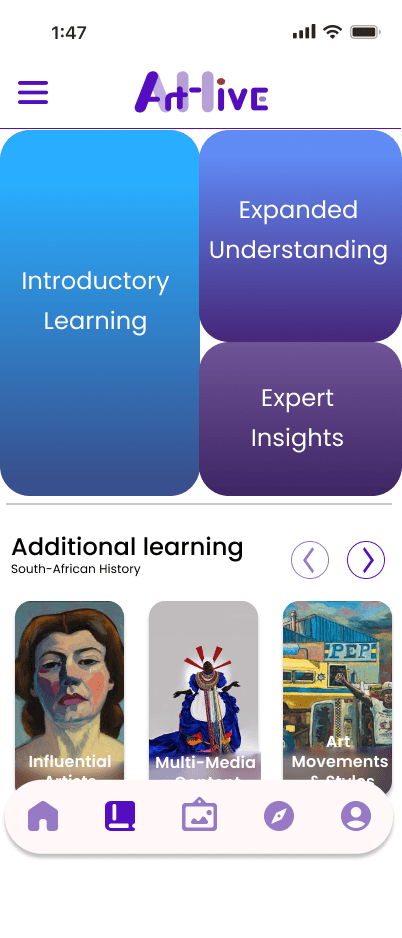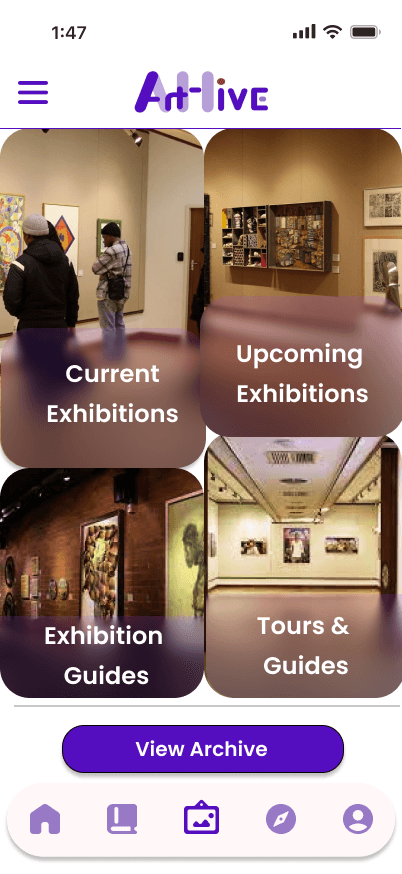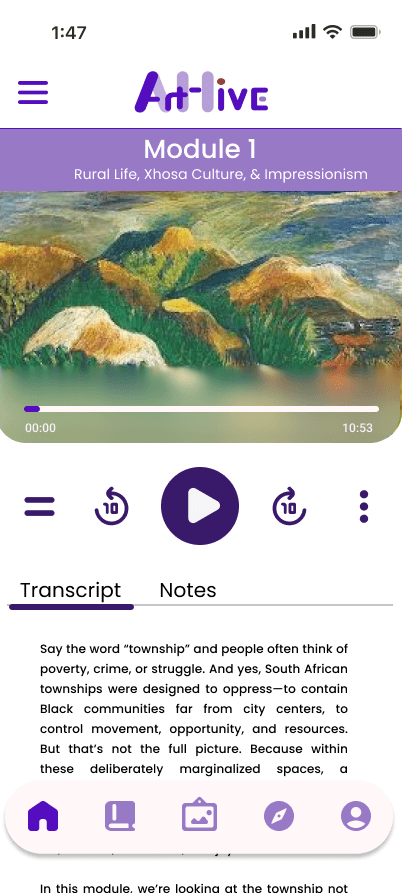



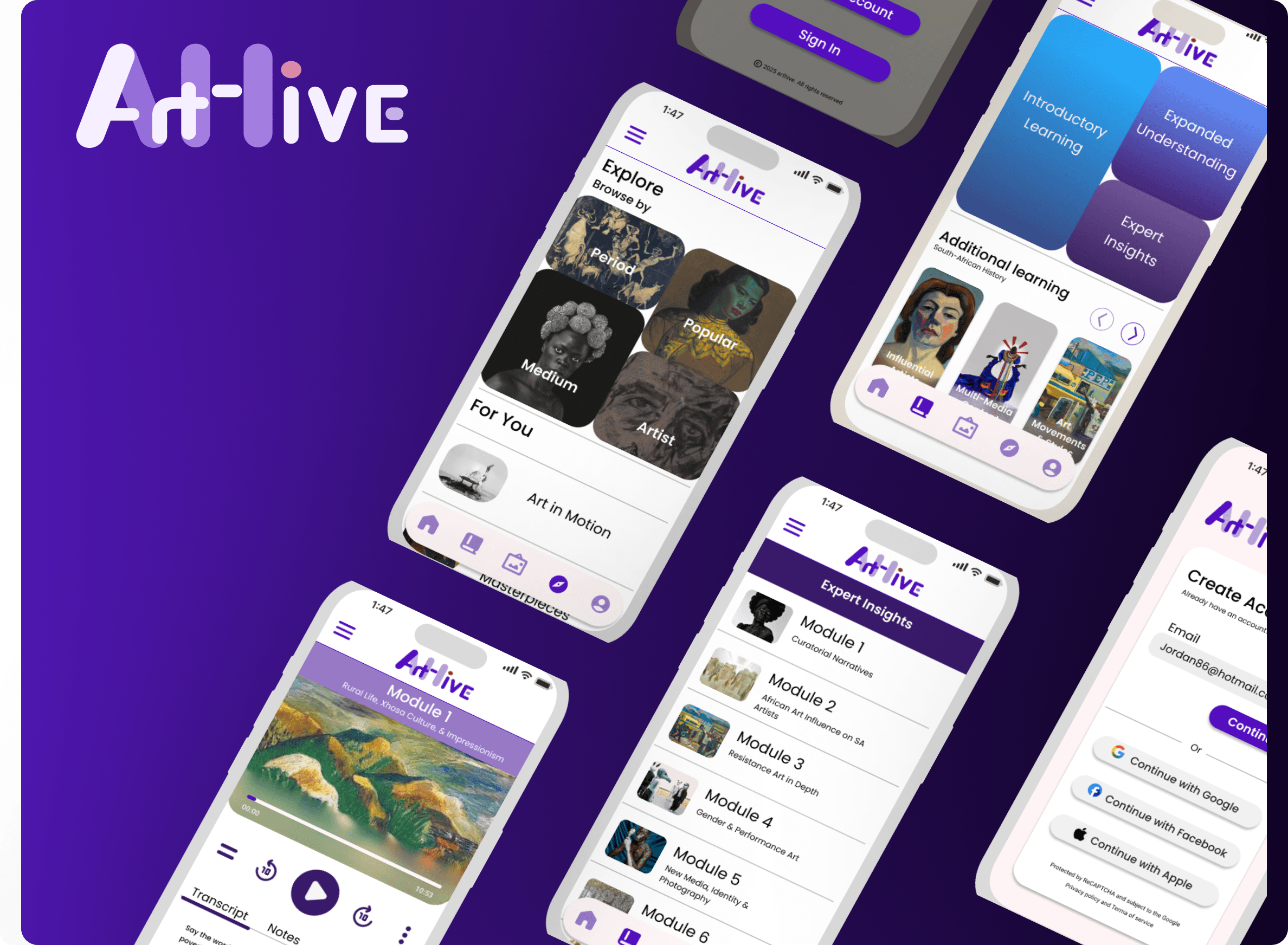
ArtHive- an educational mobile app that makes art history approachable, engaging, and relevant. The app provides a progressive learning experience -from beginner-friendly introductions to expert-level insights -so users of all backgrounds can learn at their own pace.


How ArtHive solves the problem:


Layered learning: Introductory, expanded, and expert pathways reduce intimidation, as well as provision of additional learning resources.


Relevant modules: South African art themes tie learning directly to local culture and museum exhibitions.


To make the app more fun and interactive to help retain what was learned, the app was introduced with an option to take short quizzes about the module and option to learn further about a specific artwork.


ArtHive

Problem

Solution

From the parent feedback and survey data, I was able to create User persona and - journey map:


Medium-Fidelity Wireframes

Paper-Wireframes

Mockups

Prototype

Personas and User Journey

Design

My Role:

UX / Product Designer

Duration:

12 Weeks

Kaitlyn

Bio

Grade 10-12 Art teacher

AGE 32

Bloemfontein, South Africa

Kaitlyn, a dedicated high school art teacher, with the goal to make the learning of art fun, easy and engaging for her students, Frustrated by disjointed information during exhibitions make it hard to create memorable learning experiences for herself and her students. Despite these obstacles, she envisions an app that offers a seamless, visually appealing journey, helping her transform her teaching and inspire her students.


|

|

Frustrations

Goals


To find credible, digestible content that she can share with her students for school projects.


To attend exhibitions feeling more prepared and informed, so it’s intimidating.


To connect students with local culture through art in ways they can understand

Finds museum descriptions inaccessible for everyday learners.


Struggles to keep her students engaged during gallery visits.


Wants to enjoy art in her free time but doesn’t want it to feel like “studying.”

Zaineb

Bio

Marketing Manager

AGE 29

Bloemfontein, South Africa

Zaineb is a 29-year-old marketing manager who lives a busy, fast-paced life in Bloemfontein. She loves exploring cultural activities on weekends as a way to unwind and broaden her perspective, but often feels that the art world is not designed for “normal people” like her. With limited time to dive into dense theory, she wants a simple, engaging way to understand art so she can confidently enjoy exhibitions and share those experiences with friends.

|

|

Frustrations

Goals

Learn about art in a way that’s relaxing and enriching during free time.


Explore exhibitions without feeling like an outsider.


Share cultural experiences with friends or family.

Finds traditional museum explanations too academic and alienating.


Has limited time to engage deeply with complex theory.


Feels disconnected from events because she doesn’t understand the background.

Interactive formats: Audio, transcripts, and notes cater to different learning styles, making complex concepts easy to absorb.


Direct link to exhibitions: Content is designed to spark curiosity and build anticipation for visiting events in person.

What I Learned


Progressive learning paths matter. By designing tiers (Introductory → Expert), I gave users confidence to start small and grow deeper over time.


Designing for both users and business is important. Aligning user and business goals from the start was critical, making sure both business - and user needs were met.


Areas for Improvement


Event integration: The app introduces exhibitions but could go further—like allowing users to book tickets directly or get personalized event recommendations based on their completed modules.


Gamification & rewards: To drive repeat engagement, adding badges, progress tracking, or event-based rewards could make learning more motivating.


Working Around Constraints


Limited content creation resources: One of the biggest constraints for this project was the limited resources in terms of local art history content. This lead me to explore national South African art history recourses to include in the various learning modules.


For this project I didn’t conduct any formal interviews with participants for persona development and usability study. Instead I conducted lightweight interviews to get proxy feedback as well as secondary research which gave me patterns and pain points I could identify and validate


Audience diversity: Designing for students, professionals, and casual learners is a broad spectrum. A workaround would be personalized onboarding flows that adapt the app’s content recommendations based on user goals.

Business Impact:


More engaged audiences primed to attend exhibitions.

Increased opening night attendance → secured funding sustainability.

Expanded reach through educational partnerships.

Project Impact

Let’s Connect

Art history often feels intimidating and disconnected from everyday people. Or atleast this is how the art enthusiasts of Bloemfontein described their experiences at local art exhibitions. Truth is they want to feel part of the rich history of art South-Africa has to offer. Unfortunately they don't know where to start learning, and let's be honest people don’t need theory-heavy lectures to appreciate art. Ultimately learning need to be accesible and inclusive for everyone- and that's exactly what we designed for in this project.


Key User Problem:


Normal working individuals felt art was “too academic” to enjoy casually.

Students lacked accessible, credible resources for projects.

The general public felt excluded from the cultural experience.


Business Goal:


Increase exhibition attendance to secure continued funding.

Build excitement around art and opening night events.

Make art history approachable while retaining depth and accuracy.


KPIs:


Opening night attendance

User engagement (session length, repeat visits)

Event conversion from app → exhibitions

Educational adoption (schools/universities)

User satisfaction

Action

Tasklist

Feeling

Adjective

Business

Impact

Search for art history apps on app store

Research and compare art history apps

Save favorite apps for consideration.

Explore app and master navigation

Save and take note of key learnings

Check schedule to attend

Engage with exhibition art

Feels disconnected from art,

App downloads, awareness growth

Marketing oppertunities

Increased adoption & session starts

Higher engagement & repeat sessions,

Conversion - exhibition attendance

Opening night attendance KPI met

Unsure where to start,

Curious, discover engaging features

Engaged, intrigued by relevant topics

Excited, anticipates attending

Inspired, socially connected

Download an app that fits her needs

Explore app features,

Selects a beginner-friendly module

Notices module links to an upcoming exhibition,

Attends exhibition with more context & confidence

Grethan Pienaar 2026 | Designer | grethanpienaar@gmail.com

ArtHive

My Role:

UX / Product Designer

Duration:

12 Weeks

Art history often feels intimidating and disconnected from everyday people. Or atleast this is how the art enthusiasts of Bloemfontein described their experiences at local art exhibitions. Truth is they want to feel part of the rich history of art South-Africa has to offer. Unfortunately they don't know where to start learning, and let's be honest people don’t need theory-heavy lectures to appreciate art. Ultimately learning need to be accesible and inclusive for everyone- and that's exactly what we designed for in this project.


Key User Problem:


Normal working individuals felt art was “too academic” to enjoy casually.

Students lacked accessible, credible resources for projects.

The general public felt excluded from the cultural experience.


Business Goal:


Increase exhibition attendance to secure continued funding.

Build excitement around art and opening night events.

Make art history approachable while retaining depth and accuracy.


KPIs:


Opening night attendance

User engagement (session length, repeat visits)

Event conversion from app → exhibitions

Educational adoption (schools/universities)

User satisfaction

Problem

ArtHive- an educational mobile app that makes art history approachable, engaging, and relevant. The app provides a progressive learning experience—from beginner-friendly introductions to expert-level insights—so users of all backgrounds can learn at their own pace.


How ArtHive solves the problem:


Layered learning: Introductory, expanded, and expert pathways reduce intimidation, as well as provision of additional learning resources.


Relevant modules: South African art themes tie learning directly to local culture and museum exhibitions.


To make the app more fun and interactive to help retain what was learned, the app was introduced with an option to take short quizzes about the module and option to learn further about a specific artwork.


Solution

From the parent feedback and survey data, I was able to create User persona and - journey map:


Medium-Fidelity Wireframes

Paper-Wireframes

Mockups

Prototype

Personas and User Journey

Design

Kaitlyn

Bio

Grade 10-12 Art teacher

AGE 32

Bloemfontein, South Africa

Kaitlyn, a dedicated high school art teacher, with the goal to make the learning of art fun, easy and engaging for her students, Frustrated by disjointed information during exhibitions make it hard to create memorable learning experiences for herself and her students. Despite these obstacles, she envisions an app that offers a seamless, visually appealing journey, helping her transform her teaching and inspire her students.


|

|

Frustrations

Goals


To find credible, digestible content that she can share with her students for school projects.


To attend exhibitions feeling more prepared and informed, so it’s intimidating.


To connect students with local culture through art in ways they can understand

Finds museum descriptions inaccessible for everyday learners.


Struggles to keep her students engaged during gallery visits.


Wants to enjoy art in her free time but doesn’t want it to feel like “studying.”

Zaineb

Bio

Marketing Manager

AGE 29

Bloemfontein, South Africa

Zaineb is a 29-year-old marketing manager who lives a busy, fast-paced life in Bloemfontein. She loves exploring cultural activities on weekends as a way to unwind and broaden her perspective, but often feels that the art world is not designed for “normal people” like her. With limited time to dive into dense theory, she wants a simple, engaging way to understand art so she can confidently enjoy exhibitions and share those experiences with friends.

|

|

Frustrations

Goals

Learn about art in a way that’s relaxing and enriching during free time.


Explore exhibitions without feeling like an outsider.


Share cultural experiences with friends or family.

Finds traditional museum explanations too academic and alienating.


Has limited time to engage deeply with complex theory.


Feels disconnected from events because she doesn’t understand the background.

Interactive formats: Audio, transcripts, and notes cater to different learning styles, making complex concepts easy to absorb.


Direct link to exhibitions: Content is designed to spark curiosity and build anticipation for visiting events in person.

What I Learned


Progressive learning paths matter. By designing tiers (Introductory → Expert), I gave users confidence to start small and grow deeper over time.


Designing for both users and business is important. Aligning user and business goals from the start was critical, making sure both business - and user needs were met.


Areas for Improvement


Event integration: The app introduces exhibitions but could go further—like allowing users to book tickets directly or get personalized event recommendations based on their completed modules.


Gamification & rewards: To drive repeat engagement, adding badges, progress tracking, or event-based rewards could make learning more motivating.


Working Around Constraints


Limited content creation resources: One of the biggest constraints for this project was the limited resources in terms of local art history content. This lead me to explore national South African art history recourses to include in the various learning modules.


For this project I didn’t conduct any formal interviews with participants for persona development and usability study. Instead I conducted lightweight interviews to get proxy feedback as well as secondary research which gave me patterns and pain points I could identify and validate


Audience diversity: Designing for students, professionals, and casual learners is a broad spectrum. A workaround would be personalized onboarding flows that adapt the app’s content recommendations based on user goals.

Business Impact:


More engaged audiences primed to attend exhibitions.

Increased opening night attendance → secured funding sustainability.

Expanded reach through educational partnerships.

Project Impact

Action

Tasklist

Feeling

Adjective

Business

Impact

Search for art history apps on app store

Research and compare art history apps

Save favorite apps for consideration.

Explore app and master navigation

Save and take note of key learnings

Check schedule to attend

Engage with exhibition art

Feels disconnected from art,

App downloads, awareness growth

Marketing oppertunities

Increased adoption & session starts

Higher engagement & repeat sessions,

Conversion - exhibition attendance

Opening night attendance KPI met

Unsure where to start,

Curious, discover engaging features

Engaged, intrigued by relevant topics

Excited, anticipates attending

Inspired, socially connected

Download an app that fits her needs

Explore app features,

Selects a beginner-friendly module

Notices module links to an upcoming exhibition,

Attends exhibition with more context & confidence

Let’s Connect

Grethan Pienaar 2026 | Designer | grethanpienaar@gmail.com

About

Contact

ArtHive

My Role:

UX / Product Designer

Duration:

12 Weeks

ArtHive- an educational mobile app that makes art history approachable, engaging, and relevant. The app provides a progressive learning experience—from beginner-friendly introductions to expert-level insights—so users of all backgrounds can learn at their own pace.


How ArtHive solves the problem:


Layered learning: Introductory, expanded, and expert pathways reduce intimidation, as well as provision of additional learning resources.


Relevant modules: South African art themes tie learning directly to local culture and museum exhibitions.


To make the app more fun and interactive to help retain what was learned, the app was introduced with an option to take short quizzes about the module and option to learn further about a specific artwork.


Solution

Interactive formats: Audio, transcripts, and notes cater to different learning styles, making complex concepts easy to absorb.


Direct link to exhibitions: Content is designed to spark curiosity and build anticipation for visiting events in person.

Business Impact:


More engaged audiences primed to attend exhibitions.

Increased opening night attendance-secured funding sustainability.

Expanded reach through educational partnerships.

Zaineb

Bio

Marketing Manager

AGE 29

Bloemfontein, South Africa

Zaineb is a 29-year-old marketing manager who lives a busy, fast-paced life in Bloemfontein. She loves exploring cultural activities on weekends as a way to unwind and broaden her perspective, but often feels that the art world is not designed for “normal people” like her. With limited time to dive into dense theory, she wants a simple, engaging way to understand art so she can confidently enjoy exhibitions and share those experiences with friends.

|

|

Frustrations

Goals

Learn about art in a way that’s relaxing and enriching during free time.


Explore exhibitions without feeling like an outsider.


Share cultural experiences with friends or family.

Finds traditional museum explanations too academic and alienating.


Has limited time to engage deeply with complex theory.


Feels disconnected from events because she doesn’t understand the background.

Kaitlyn

Bio

Grade 10-12 Art teacher

AGE 32

Bloemfontein, South Africa

Kaitlyn, a dedicated high school art teacher, with the goal to make the learning of art fun, easy and engaging for her students, Frustrated by disjointed information during exhibitions make it hard to create memorable learning experiences for herself and her students. Despite these obstacles, she envisions an app that offers a seamless, visually appealing journey, helping her transform her teaching and inspire her students.


|

|

Goals

Frustrations


To find credible, digestible content that she can share with her students for school projects.


To attend exhibitions feeling more prepared and informed, so it’s intimidating.


To connect students with local culture through art in ways they can understand

Finds museum descriptions inaccessible for everyday learners.


Struggles to keep her students engaged during gallery visits.


Wants to enjoy art in her free time but doesn’t want it to feel like “studying.”

Action

Tasklist

Feeling

Adjective

Business

Impact

Search for art history apps on app store

Research and compare art history apps

Save favorite apps for consideration.

Explore app and master navigation

Save and take note of key learnings

Check schedule to attend

Engage with exhibition art

Feels disconnected from art,

App downloads, awareness growth

Marketing oppertunities

Increased adoption & session starts

Higher engagement & repeat sessions,

Conversion - exhibition attendance

Opening night attendance KPI met

Unsure where to start,

Curious, discover engaging features

Engaged, intrigued by relevant topics

Excited, anticipates attending

Inspired, socially connected

Download an app that fits her needs

Explore app features,

Selects a beginner-friendly module

Notices module links to an upcoming exhibition,

Attends exhibition with more context & confidence

Personas and User Journey

From the parent feedback and survey data, I was able to create User persona and - journey map:


What I Learned


Progressive learning paths matter. By designing tiers (Introductory → Expert), I gave users confidence to start small and grow deeper over time.


Designing for both users and business is important. Aligning user and business goals from the start was critical, making sure both business - and user needs were met.


Areas for Improvement


Event integration: The app introduces exhibitions but could go further—like allowing users to book tickets directly or get personalized event recommendations based on their completed modules.


Gamification & rewards: To drive repeat engagement, adding badges, progress tracking, or event-based rewards could make learning more motivating.


Working Around Constraints


Limited content creation resources: One of the biggest constraints for this project was the limited resources in terms of local art history content. This lead me to explore national South African art history recourses to include in the various learning modules.


For this project I didn’t conduct any formal interviews with participants for persona development and usability study. Instead I conducted lightweight interviews to get proxy feedback as well as secondary research which gave me patterns and pain points I could identify and validate


Audience diversity: Designing for students, professionals, and casual learners is a broad spectrum. A workaround would be personalized onboarding flows that adapt the app’s content recommendations based on user goals.

Project Impact

Let’s Connect

Design

Paper-Wireframes

Medium-Fidelity Wireframes

Mockups

Prototype

Art history often feels intimidating and disconnected from everyday people. Or atleast this is how the art enthusiasts of Bloemfontein described their experiences at local art exhibitions. Truth is they want to feel part of the rich history of art South-Africa has to offer. Unfortunately they don't know where to start learning, and let's be honest people don’t need theory-heavy lectures to appreciate art. Ultimately learning need to be accesible and inclusive for everyone- and that's exactly what we designed for in this project..


Key User Problem:


Normal working individuals felt art was “too academic” to enjoy casually.

Students lacked accessible, credible resources for projects.

The general public felt excluded from the cultural experience.


Business Goal:


Increase exhibition attendance to secure continued funding.

Build excitement around art and opening night events.

Make art history approachable while retaining depth and accuracy.


KPIs:


Opening night attendance

User engagement (session length, repeat visits)

Event conversion from app → exhibitions

Educational adoption (schools/universities)

User satisfaction

Problem

Grethan Pienaar 2026 | Designer | grethanpienaar@gmail.com